.svg "Shoppable Vertical Logo (1)")

What is universal checkout? The technology reshaping commerce in the AI era
Universal checkout lets shoppers buy any product from any retailer in a single cart — without leaving the page they're on. Shoppable® invented and patented this technology in 2011. More than a decade later, it's become the infrastructure on which the agentic commerce era is being built.
The definition: what universal checkout actually means
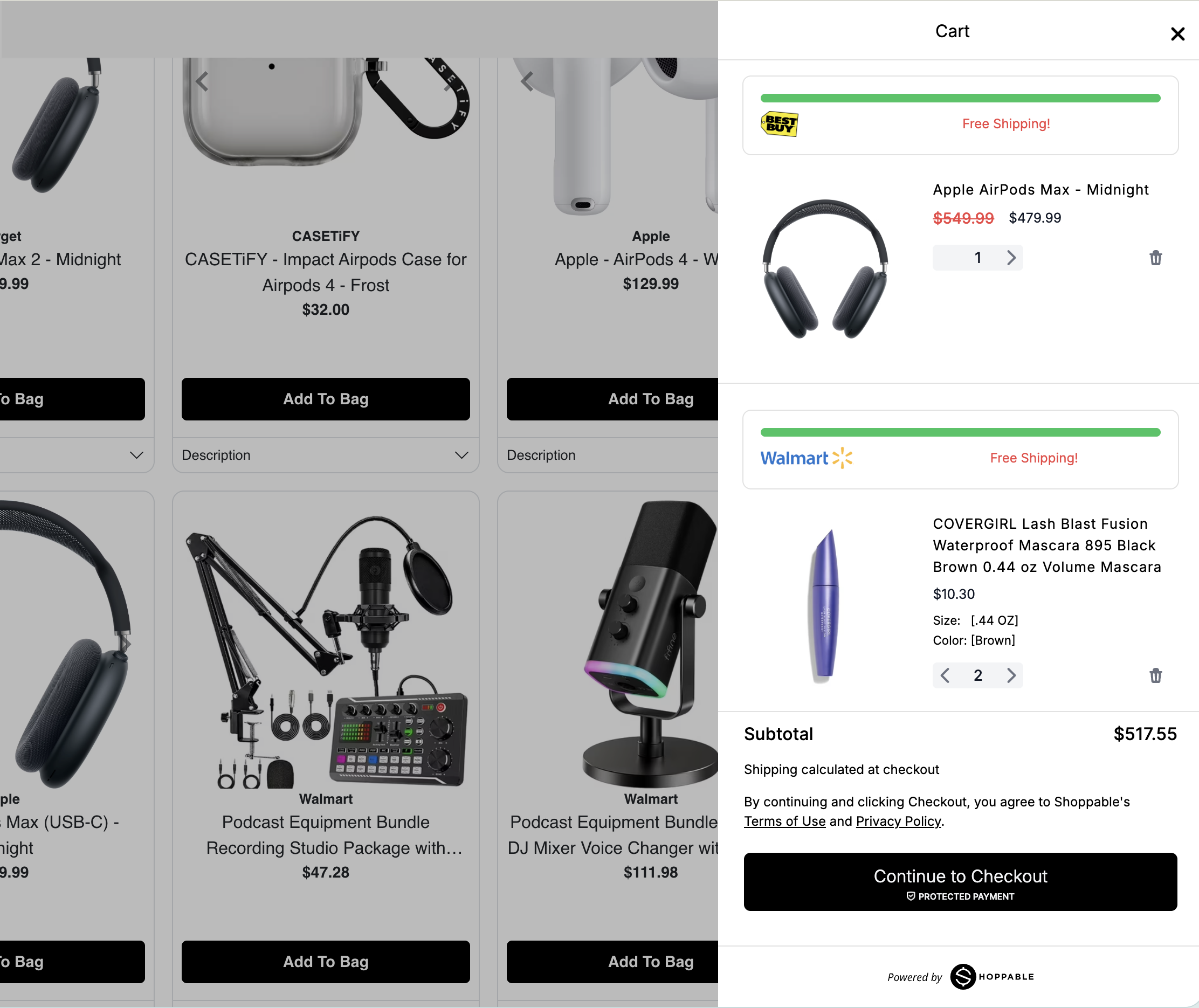
Universal checkout is an online shopping technology that allows a consumer to purchase products from multiple retailers, in a single cart, from a single checkout flow, without ever being redirected to a retailer's website.
In plain terms: a shopper can see a product in an article, an ad, a video, or an AI conversation, click to buy it, and complete the transaction right there. No new browser tab. No login. No re-entering credit card information. One experience, any surface, any retailer.
Shoppable® created and patented this technology in 2011. At the time, it was a radical departure from how e-commerce worked. Today, as AI agents help shape how people discover and buy products, this technology has become the foundational infrastructure layer for a new era of commerce.
DEFINITIONUniversal checkout (noun):
A commerce technology that enables shoppers to purchase products from one or more retailers within a single embedded checkout experience — at any digital touchpoint, without leaving that touchpoint. Coined and patented by Shoppable® in 2011.
How universal checkout works, step by step
Most people have experienced what universal checkout replaces: you find a product recommendation in a blog post, click the link, get redirected to a retailer, discover it's out of stock, navigate back, try a different link, and enter your payment details from scratch. Universal checkout eliminates every one of those steps.
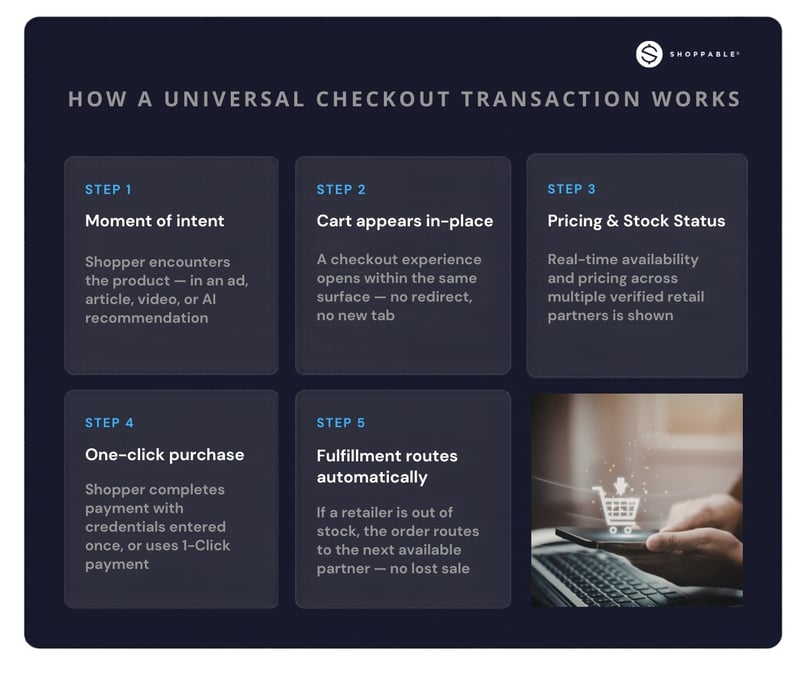
Behind the scenes, Shoppable®'s infrastructure connects a brand's product catalog to a network of verified partners. When a consumer initiates a purchase, the system pulls pricing and inventory data, presents the product from the available merchant, processes payment in a PCI-compliant environment, and routes the order to the fulfillment partner.
Because Shoppable can automatically route the order to another in-stock retailer, brands and shop owners almost never lose a sale when one retailer runs out. The consumer never loses their momentum. And the publisher or platform hosting the experience captures the conversion at the exact moment of intent.
Universal checkout vs. traditional affiliate links
The most common alternative to universal checkout is still the traditional affiliate link: a redirect to a single retailer's product detail page. It's been the commerce backbone of publisher monetization for decades. It also fails in predictable, costly ways.
| Feature | Traditional affiliate link | Universal checkout |
|---|---|---|
| Stays on same page | No — redirects to retailer | Yes — embeds in-place |
| Multiple retailers | No — single merchant only | Yes — unified in a single checkout page |
| Out-of-stock protection | No — sale is lost | Yes — auto-routes to next retailer |
| Updated pricing | No — static link | Yes — live feeds |
| Works in AI surfaces | No | Yes — API-native |
| PCI-compliant checkout | Depends on the retailer | Yes — handled by Shoppable® |
| Brand controls the experience | No — retailer controls | Yes — brand-native cart |
| Works across CTV, social, video, and email | Limited, must forward the shopper away from the experience | Yes — any digital surface |
"For years, we've watched billions of dollars in brand intent leak from each click the consumer is forced to make.
Affiliate links have always asked the consumer to leave the moment that inspired them to buy. Universal checkout brings the transaction to that moment instead, so brands capture the sale without ever breaking the experience."
— Heather Udo, CEO & Co-Founder, Shoppable®
Where universal checkout lives: every surface, not just your store
One of the most powerful properties of universal checkout is that it's surface-agnostic. Commerce doesn't have to live on a brand's owned website. It can — and increasingly does — live everywhere a consumer's attention goes.
Shoppable® calls this distributed commerce: the ability to make any digital touchpoint, or mention of a product, transactable. Universal checkout is the technology that makes a piece of content, an ad, or a conversation shoppable at the moment a consumer decides they want something.
Universal checkout is currently powering Shoppable experiences across:
Each of these surfaces represents a moment of intent — a point where a consumer encounters something they want to buy. Without universal checkout, that intent is routinely lost to friction. With it, the transaction completes in the same moment the decision is made.
Why global brands rely on universal checkout
Shoppable® has licensed its universal checkout infrastructure to Fortune 500 companies, large publishers, and adtech platforms. These companies share a structural challenge that universal checkout is uniquely positioned to solve.
They don't own the point of sale
Many large brand manufacturers don't sell directly to consumers at scale; they sell through retail partners: Target, Walmart, Amazon, CVS, and hundreds of others. This creates a problem: the brand owns the advertising and the inspiration, but the retailer captures the transaction and the information on their customers. Universal checkout gives the brand a way to own the commerce layer without building a full D2C operation and creating channel conflict with their retail channels.
They need supply chain resilience
When a single retail partner's feed has an error, or a SKU goes out of stock, a traditional affiliate link sends the consumer to a dead end. Universal checkout routes the sale to the next available retailer automatically, within the same checkout experience. Brands using Shoppable® don't lose sales to inventory gaps they can't control.
They want conversion at the point of inspiration
The moment a consumer decides they want something is the highest-intent moment in the purchase journey. Every additional click between that moment and the completed purchase increases the probability of abandonment. Universal checkout collapses that distance to zero.
Universal checkout and the agentic commerce revolution
If 2025 was the year that AI learned to recommend products, 2026 is the year AI agents have started completing purchases. This shift, from AI as advisor to AI as buyer, is the most significant structural change in e-commerce since the smartphone.
The numbers reflect the pace of change. AI-referred traffic to U.S. retail sites grew 805% year-over-year on Black Friday 2025. Shoppers arriving from AI surfaces are 38% more likely to convert than those from traditional channels. McKinsey projects agentic commerce could influence $3–5 trillion in global retail spend by 2030.
Here is the critical insight that most brands are missing: agentic commerce doesn't work without a checkout infrastructure that AI can invoke. An AI agent can surface a product recommendation in a conversation. But to complete the transaction, it needs an API endpoint that supports cart creation, inventory validation, payment processing, and order confirmation — all in a single, structured flow.
That is exactly what universal checkout is. Shoppable® built it in 2011 for human shoppers. In 2026, it's the infrastructure that AI agents use to complete purchases.
In agentic commerce, the AI agent — not the consumer — decides which product to recommend and which retailer to buy from. Brands that aren't discoverable by AI agents, and whose products can't be transacted through an agentic checkout layer, will not appear in the new purchase flow at all. Shoppable®'s universal checkout is the infrastructure that ensures your products remain transactable everywhere intent exists, including inside AI.
Shoppable's Universal Commerce Platform: universal checkout for the AI era
Shoppable®'s turnkey product offering for global brand manufacturers is called DTC Lite. It's built on the same patented universal checkout infrastructure the company has operated for 15 years, extended for the agentic commerce era.
DTC Lite gives large CPG and brand manufacturers a distributed commerce layer that works across every surface where their consumers exist: shoppable ads, publisher content, CTV, social platforms, and AI-powered assistants. It is not a storefront replacement. It is the checkout infrastructure for everywhere that isn't a brand's owned store.
Built for brand manufacturers who don't control the shelf
Shoppable® DTC Lite is designed specifically for the structural reality of global CPG and brand manufacturing: brands spend billions on advertising, content, and consumer inspiration, but the transaction still happens at a retailer the brand doesn't control. DTC Lite changes that equation without requiring brands to disintermediate their retail partners or build a full D2C operation from scratch.
The two-platform strategy for retailers
The retailers and D2C brands Shoppable® partners with often already have a traditional e-commerce store. Shoppable is the second platform, the one that makes everything outside a brand's owned website shoppable.
One platform for your store. One for everywhere else.
MCP-ready for the agentic layer
Shoppable® has built its commerce infrastructure on Model Context Protocol (MCP) — the emerging open standard for AI-to-tool connectivity. This means Shoppable®'s universal checkout can be invoked by AI agents and assistants directly, making brand products transactable inside any MCP-compatible AI surface. It is the connective tissue between a brand's product catalog and the AI assistants that are rapidly becoming the new point of discovery and purchase for consumers.
Frequently asked questions about universal checkout
What exactly is universal checkout?
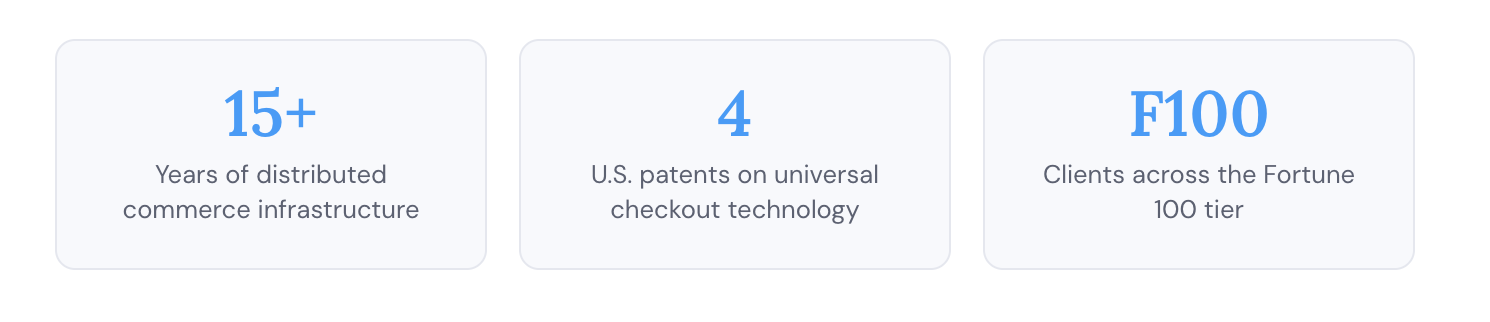
Universal checkout is a commerce technology that allows shoppers to purchase products from one or more retailers within a single, embedded checkout experience, without being redirected away from the content they're viewing. Shoppers enter payment and shipping information once and complete their transaction at the point of inspiration. Shoppable® invented and patented universal checkout in 2011 and holds four U.S. patents on the underlying technology.
How is universal checkout different from Buy Now buttons?
A "Buy Now" button from a single retailer (like an Amazon Buy Now button) links to one retailer's checkout for one merchant's inventory. Universal checkout supports multiple retail partners simultaneously, shows updated pricing and stock, routes around out-of-stock situations automatically, and embeds natively within any surface, including AI-powered environments. The consumer never leaves the experience they're in.
Is universal checkout the same as Google's Universal Commerce Protocol (UCP)?
No. Google's Universal Commerce Protocol (UCP), announced in January 2026, is its standard for how AI agents communicate with merchant backends to execute purchases. It is a protocol, a technical communication standard. Universal checkout, as invented by Shoppable®, is the checkout infrastructure itself: the product catalog connection, multi-retailer cart, real-time inventory system, payment processing layer, and embedded checkout experience. UCP and similar agentic protocols describe how AI agents request a purchase; Shoppable®'s universal checkout is what fulfills it.
What does "transactability" mean in commerce?
Transactability refers to the ability of any digital surface — an ad, a piece of content, an AI conversation, a social post — to complete a purchase transaction. A surface is "transactable" when it includes a checkout layer that can capture the consumer's purchase intent and convert it into a completed order without redirecting to another site. Universal checkout is the technology that makes surfaces transactable.
Can universal checkout work with AI shopping agents?
Yes. Shoppable®'s universal checkout infrastructure is built to be invoked by AI agents, including those built on Model Context Protocol (MCP), OpenAI's Agentic Commerce Protocol (ACP), or Google's Universal Commerce Protocol (UCP). When an AI agent identifies a product a consumer wants to purchase, it can invoke Shoppable®'s checkout layer to execute the transaction, validate inventory, process payment, and confirm the order, all within the AI surface, without requiring a redirect to a retailer site.
What is DTC Lite from Shoppable®?
DTC Lite is Shoppable®'s product offering for publishers, global brand manufacturers — CPG companies, personal care brands, and consumer goods companies — that need a commerce layer for every digital surface, including their owned website. It combines universal checkout technology with multi-retailer inventory management, real-time pricing feeds, and AI-compatible API endpoints. It is designed as the second platform in a two-platform commerce strategy: one platform for the brand's owned store, and DTC Lite for everywhere else.
Make your brand transactable everywhere
DTC Lite gives global brand manufacturers universal checkout infrastructure for every surface — from shoppable ads to AI agents — without rebuilding their retail relationships.